

Most people know “pleading the Fifth” as a way to avoid answering an incriminating question. Yet that famous right is only one part of a much broader set of constitutional protections.
The Fifth Amendment protects people from several forms of government overreach. It requires a grand jury indictment for many serious federal prosecutions, prohibits double jeopardy, protects against compelled self-incrimination, guarantees due process, and requires compensation when the government takes private property for public use. We break this down further in Public Nudity Explained.
This article is for general educational purposes and does not provide individual legal advice. Bloggingley also maintains a site-wide disclaimer. Readers interested in similar topics can explore Bloggingley’s Law section.
Key Protections at a Glance
| Protection | Plain-English Meaning | Common Context |
| Grand jury | Many serious federal charges require a grand jury indictment | Federal criminal cases |
| Double jeopardy | The same sovereign generally cannot prosecute someone twice for the same offense after jeopardy has ended | Criminal trials |
| Self-incrimination | The government generally cannot compel someone to provide incriminating testimonial evidence | Trials, investigations, and hearings |
| Due process | The federal government must follow constitutional standards before depriving someone of life, liberty, or property | Criminal and civil government actions |
| Takings | When the government takes private property for public use, it generally must provide just compensation | Eminent domain and property disputes |
These protections come directly from the Fifth Amendment to the U.S. Constitution, which is part of the Bill of Rights.
What Rights Does the Fifth Amendment Protect?
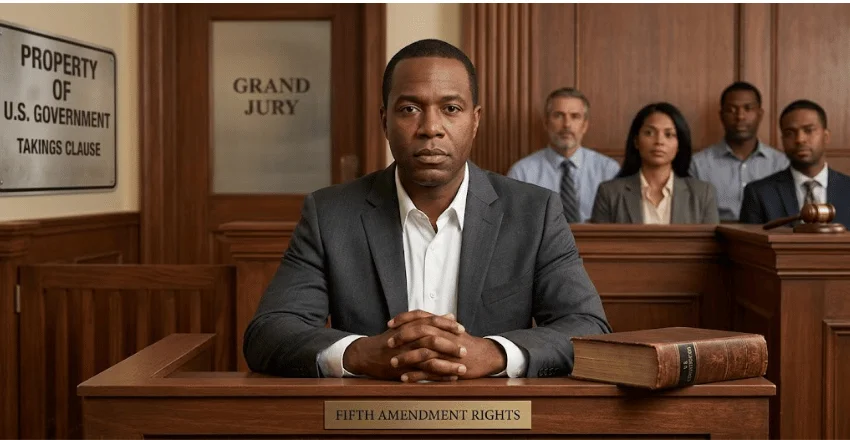
The amendment contains five major protections. They cover criminal procedure, fairness in government action, and private property rights.
1. Grand Jury Protection
For many serious federal crimes, prosecutors generally need a grand jury indictment before taking a defendant to trial. A grand jury determines whether sufficient grounds exist to bring formal criminal charges.
There is an important distinction between federal and state proceedings. The federal grand jury requirement does not apply to the states in the same way. States may therefore use other charging procedures in circumstances where a federal prosecution would require an indictment. For a closer look at this, see Due on Sale Clause.
2. Protection Against Double Jeopardy
Double jeopardy generally prevents the government from repeatedly prosecuting a defendant for the same offence after an acquittal or conviction. The protection limits the government’s ability to keep retrying a person until it obtains the result it wants. More from us: Hawaii Unemployment Benefits.
The rule has limits. For example, a mistrial can affect whether another trial is permitted. Prosecutions brought by separate sovereign governments may also be treated differently under the dual-sovereignty doctrine.
3. Protection Against Compelled Self-Incrimination
This protection is the source of the phrase “plead the Fifth.” A person may invoke the privilege when a compelled testimonial answer could create a reasonable risk of criminal prosecution.
The protection focuses primarily on testimonial communication. It does not create a general constitutional right to refuse fingerprints, handwriting samples, or blood samples simply because that evidence could be incriminating.
4. The Right to Due Process
The Due Process Clause protects people from certain federal government actions that deprive them of life, liberty, or property without due process of law.
Due process can involve both the procedures the government must follow and broader constitutional limits on government action.
The Fourteenth Amendment contains a separate Due Process Clause that applies to state governments. This distinction explains why discussions of constitutional due process often involve both amendments.
5. Protection When the Government Takes Private Property
The Takings Clause requires just compensation when the government takes private property for public use. This protection is closely associated with eminent domain.
In practical terms, the government generally cannot take qualifying private property for public use without compensating the property owner.
What Does “Pleading the Fifth” Mean?
Taking the Fifth means invoking the constitutional privilege against compelled self-incrimination. It does not mean that a person can refuse to answer every question they dislike.
A person generally needs a legitimate concern that an answer could expose them to criminal liability. Whether the privilege properly applies can depend on the circumstances and the nature of the question.
The privilege may also arise outside a criminal trial. For example, witnesses may invoke it during certain government investigations or civil proceedings when their answers could expose them to criminal prosecution.
Civil proceedings involve an important distinction. In some noncriminal cases, a court or factfinder may be permitted to draw an adverse inference from a person’s refusal to answer certain questions.
How Miranda Warnings Fit In

Miranda rights are closely connected to the constitutional protection against self-incrimination, but the two concepts are not identical.
Miranda warnings generally relate to custodial interrogation. Police typically must provide these warnings before questioning a person who is in custody under circumstances covered by the rule.
This means Miranda warnings are not automatically required before every conversation with police. Whether a person is in custody and whether interrogation is taking place are central considerations.
Does the Fifth Amendment Apply in State Courts?
Many protections associated with the Fifth Amendment apply to state governments through constitutional principles involving the Fourteenth Amendment.
The grand jury requirement is an important exception. The federal constitutional requirement for a grand jury indictment does not bind the states in the same way that many other protections do.
Due process also illustrates the distinction between federal and state governments. The Fifth Amendment restricts the federal government, while the Fourteenth Amendment contains a Due Process Clause that directly applies to state governments.
Common Misunderstandings to Avoid

Several popular descriptions make these constitutional rights sound broader than they actually are:
Taking the Fifth is not an admission of guilt. It is the exercise of a constitutional privilege against compelled self-incrimination.
Double jeopardy does not prohibit every second proceeding. Circumstances such as mistrials and prosecutions by separate sovereigns can affect the analysis.
The privilege does not protect every form of evidence. Constitutional law distinguishes testimonial communication from certain types of physical evidence.
Miranda rights and the Fifth Amendment privilege are related but different. Miranda focuses on safeguards surrounding custodial interrogation.
These distinctions matter because constitutional protections often depend on the circumstances, the type of evidence involved, and which government authority is acting.
Why This Constitutional Protection Still Matters
The Fifth Amendment does far more than give defendants a right to remain silent. Its five major protections place different limits on how the government can investigate, prosecute, punish, and take private property.
Understanding these distinctions can make constitutional news, criminal cases, and court decisions easier to follow. For more educational content, readers can explore Bloggingley’s Education section.
If you are facing an investigation, subpoena, criminal charge, or property dispute, consider seeking advice from a qualified attorney in the relevant jurisdiction. The exact protections available can depend heavily on the facts and procedural circumstances.
Frequently Asked Questions
Yes. The privilege against self-incrimination can apply in a civil proceeding when an answer could expose a person to criminal liability.
The consequences may differ from those in a criminal trial. In some civil or disciplinary proceedings, a court or factfinder may be permitted to draw an adverse inference from a person’s refusal to answer.
No. There generally must be reasonable grounds to fear that an answer could be incriminating.
The privilege is not designed to help someone avoid a question merely because it is uncomfortable, embarrassing, or inconvenient.
No. Invoking a constitutional privilege does not establish guilt.
The protection exists so that the government cannot compel a person to provide testimonial evidence that could incriminate them.
Yes, depending on the circumstances.
Double jeopardy questions can involve several factors, including whether jeopardy had attached, how the first proceeding ended, and whether separate sovereign governments are bringing the prosecutions.
Not in the same way that it protects compelled testimony.
Constitutional law distinguishes testimonial communications from certain forms of physical evidence, such as fingerprints, handwriting samples, and blood samples.